
sit down and listen
a homily for six of my favorite people

This past Thursday night, in Davis Chapel at Wake Forest Baptist Medical Center in Winston-Salem, North Carolina, in the presence of their families, friends, and co-workers, we sang, prayed, celebrated, and blessed six graduates from the CareNet Residency in Psychotherapy and Spirituality: Dorothy, Melissa, Ijeoma,Jessica, Chatty and Claire. There was so much love in the room. I felt it in my body then and feel it now, remembering and writing about it.
I’ve been director of the CareNet Residency since 2008. It’s been one of the deep joys of my life, and the people I’ve come to know through this work are among the people I love most in the world. CareNet is an outpatient counseling subsidiary of the Wake Forest Baptist Health network (which is now connected with two other large healthcare networks, Atrium Health and Advocate Health). CareNet Residents are associate-licensed psychotherapists, employed in one of six CareNet counseling centers across North Carolina (as far west as Marion in the mountains, as far east as Wilmington on the coast). In addition to doing their work as counselors, they meet regularly for training, supervision, personal support, and professional identity formation. The Residency is a two-year program. We welcome a new cohort every September and graduate a group every August.
Growing into the work of therapy involves way more than learning psychological theory and practical skills. It requires a level personal development that can happen only when people explore their own experience deeply and in the presence of others. Year after year, our residency groups come to trust each other, take risks together that involve great vulnerability, and consequently grow incredibly close to one another. It is inspiring to be part of it, and our graduation services, coming at the end of these intense two years are almost always powerful experiences.
What follows is the homily I wrote for Thursday night. I added and omitted things as I spoke, but this is the gist of it.
Now as they went on their way, he entered a certain village where a woman named Martha welcomed him. She had a sister named Mary, who sat at Jesus’s feet and listened to what he was saying. But Martha was distracted by her many tasks, so she came to him and asked, “Lord, do you not care that my sister has left me to do all the work by myself? Tell her, then, to help me.” But the Lord answered her, “Martha, Martha, you are worried and distracted by many things, but only one thing is needed. Mary has chosen the better part, which will not be taken away from her.” (Luke 10: 38-42)
This is a night of joy and sorrow. We are truly joyful about all the good things that have happened in the past two years: the people you have served in your counseling practices; the relationships you have formed in your centers and with one another; the learning—the professional learning and personal learning--you have invested in so while-heartedly; and mostly, the love that has grown between you, between us, and within us and that we feel so strongly tonight.
What you do in your therapy offices and what we do together in residency is confidential. And if I can say this next part and still keep faith with confidentiality, I want everyone here to know—but especially the family and friends who are here with you--that each one of you is, most importantly, a remarkable person, but also a remarkable therapist. And I’m not saying that just on hearsay. We get to watch video recordings of you working, so I’m saying it because I’ve seen it and heard it.
Each one of you has leaned into uneasiness and fear because you wanted to grow more fully into your high calling. I imagine the people who know you best have been aware of change and growth in you. Robert, Erin, and I have witnessed this, too, and we honor your gifts, your intelligence, your compassion, your grit, your bravery, and your big loving hearts, all of you. You have been an inspiration to us, to me, and while I know we will stay in touch and stay connected, we won’t ever again be doing what we’ve done the past two years, and we are going to miss each other. I am going to miss you. Thus the sadness.
One of the things we have been doing together the past two years is exploring what it means to be spiritual, how the spiritual lives of people who come for counseling can be a resource for them but also, sometimes, a source of pain or trouble for them, sometimes both, and also how our own spiritual lives, our own deep experience of a presence greater than we are, our own sense of being guided by that presence, and our own willingness to trust that presence moment to moment in our work with others, how that is a part of the work we do.
So we can hear a story like the one Erin read and understand with our minds but also feel in our bones that this isn’t just a story about Jesus, Martha, and Mary; this is a story about us, about who we are, and about the work we do as therapists.
I want to begin by apologizing to someone, whom I am not going to name. But last month I overheard them say they are tired of this story. And if I understood them right, what they were tired of is the way this story feels like a chastisement of all of us who operate from the Martha role and with Martha energy--which is all of us. We all get so caught up in what we are doing, in what needs doing. And what needs doing can feel endless, and we want to do a good job, or we want to make sure everything is OK for everybody, and we’re doing the best we can, and there's never enough time. So we get to the end of the story and hear Jesus say to us, who have been working, that our sister Mary--who has just been sitting there, to hear Jesus say that what she has been doing is better than what we have been doing, it can feel very unfair, like Jesus doesn't understand, like he’s kicking us when we’re down.
I’d been feeling drawn to this story for a few months and thinking about talking about it with you. And when I overheard this person sigh with weariness about this story, I thought, “Oh, I better pick a different one.” But I kept on being drawn to this story. And I'm sure there were many reasons for that, and I’m sure I don't know the half of them, but I think at least one of them was, and is, that this is a story of two sisters, and I’m talking with a group of six sisters.
So, sisters, from a brother, here are just a few reflections for the road.
First of all, let's notice what comes before this story and what comes after. What comes before is the story of the Good Samaritan, which is about a man helping someone who is physically injured, tending their wounds, and taking them someplace for additional care. In other words, it’s a story about doing what Martha would have done.
And what comes after is a story about prayer. Jesus goes away to pray. He comes back. One of his disciples asks him how to pray. Jesus tells him.
And in between the Good Samaritan story and the prayer story is the Mary and Martha story. It’s the centerpiece of the three.
There are explicit questions connected to the Good Samaritan story: “Who is my neighbor?” and “Which one acted like a neighbor?” There’s an explicit question in the prayer story: “How shall we pray?” And I think there’s an implicit question in the Mary and Martha story: Is it possible to both at the same time? Can we do concrete acts of service and pray at the same time. To borrow the words of Saint Paul, is it possible to pray without ceasing, to pray even while we’re serving?
And if I had to describe the deepest part of what we’ve been doing together the past two years, that’s what I’d say. We’ve been asking and exploring this question: Is it possible to be a therapist—which means, in a way, to be an innkeeper to whom wounded people are brought for the longer-haul care they need after the trauma of being attacked and nearly killed—is it possible to do that while being connected to the stirring of spirit in our own mind, body, and heart? Is it possible to do the Martha part and the Mary part?
Jesus needed them both.
Did you ever think that maybe Martha and Mary were Jesus’s therapists? I mean, what he was doing was hard, and there are several places in the Scripture where we’re given a feel for the toll it took on him. Did you ever think that Martha’s house was where Jesus went when he needed a partial hospitalization program?
Jesus needed both of them, and we need both of them to do our work well. It takes some Martha and some Mary to be a therapist. We welcome people like Martha did. We help them feel at home in our space. We get the paperwork right. Maybe get them to do a PHQ-9, or a safety plan, or we teach them an emotional regulation skill, or we brainstorm options with them. We do things, like Martha. My dad sometimes teases me: “Russell, you’ve got an easy job. All you have to do is ask people, ‘How does that make you feel?’” But there’s a little more to it than that.
And, like Mary, whom the story says sat at Jesus’s feet and listened to him, we sit at the feet of our clients and listen.
Sitting is a spiritually powerful symbol and action. The shad in Upanishad—the Upanishads are one of the Hindu scriptures—shad means, literally, “to sit reverently” or “to sit down inside oneself.” When Jesus begins delivering the Sermon on the Mount, the Gospel of Matthew says, “He sat down.” Mary sits. And we sit with our clients. We sit down inside ourselves with our clients.
And we listen. We listen with respect. We remember that they know more than we do. We listen with reverence. We remember we’re listening to Jesus.
Jesus said, I am the person who is thirsty, I am the person who is hungry, I am the one who needs clothes, I am the one in prison, I am the one who is sick. Can we add: I am the one with a broken, scattered heart who needs therapy?
So we sit at our client Jesus’s feet. And give him, give her, give them, our mind-body-heart-spirit-whole-self, reverent, full attention.
Sometimes it feels easy to do both, to be Martha and Mary, and sometimes it doesn’t. And when it doesn’t, sometimes it’s because the Martha in us loses connection with Mary and Jesus.
The story says Martha was “distracted by all her service.”
The word “service” in the Greek is diakonia. That word is used 30-something times in the New Testament . It’s usually translated “deacon” (diakonia). Sometimes it’s translated “ministry.” Martha was distracted by her ministry.
Then there’s the word “distract.” It ends with “tract.” Can you think of a word that begins with “tract”?
Tractor.
And what does a tractor do?
It pulls things. It drags things around. Martha’s getting dragged around.
And that’s the picture not just in the English translation, but in the New Testament Greek, too. The word there is periespato. Peri means “around,” like “perimeter.” Spato means “to drag.”
So Martha, in Greek and in English, was getting tractored. She was being dragged apart by all her service.
Dragged apart from Jesus. Dragged apart from Mary. Dragged apart from herself.
So, when Jesus says to Martha, “there is need of only one thing” . . . what does that mean? What is the only one thing that’s needed?
Jesus doesn’t say. The writer of the story doesn’t say. And I can’t say.
But the story does drop those hints that the one thing needed has something to do with sitting down and listening. Sitting down with Jesus, sitting down inside ourselves, sitting down in our nervous systems, in the presence of others, and listening, and not letting ourselves be tractored, not letting ourselves be drawn apart.
To be not drawn apart is to be drawn together, is to be gathered and held together. To be distilled and concentrated. Not concentrating, with effort, but concentrated--by the force of some powerful gravitational energy that you could call heart, or soul, or spirit.
Howard Thurman called it “the sound of the genuine.”
You probably know, but in case you don’t, Howard Thurman was a minister, a theologian, a civil rights leader. He was a mentor to Martin Luther King, Jr., and one of the founders of interracial, interspiritual Church for the Fellowship of All Peoples in San Francisco in 1944. But above all, or maybe beneath all, he was a mystic, he was a Mary, he was gathered together by and within the one thing necessary.
In 1980, at age 80, the year before he died, Dr. Thurman gave the graduation address at Spelman College. Spelman is a historically Black college for women in Atlanta.
You can listen to it on YouTube, and I hope you will, but here are a few lines from that speech:
There is something in every one of you that waits, listens for the sound of the genuine in yourself. And if you cannot hear it, you will never find whatever it is for which you are searching. And if you hear it and then do not follow it, it was better that you had never been born…
Howard Thurman wasn’t messing around.
You are the only you that has ever lived. Your idiom is the only idiom of its kind in all of existence. And if you cannot hear the sound of the genuine in you, you will all of your life spend your days on the ends of strings that somebody else pulls…
There is in you something that waits and listens for the sound of the genuine in yourself. And sometimes there is so much traffic going on in your minds, so many different kinds of signals, so many vast impulses floating through your organism that go back thousands of generations . . . and you are buffeted by these. And in the midst of all of this you have got to find out what your name is. Who are you? How does the sound of the genuine come through to you…
It doesn’t matter whether I become a doctor, lawyer, housewife. I’m secure because I hear the sound of the genuine in myself and having learned to listen to that, I can become quiet enough, still enough, to hear the sound of the genuine in you.
We connect to others in meaningful, healing ways, when we are hearing the sound and feeling the vibration of the genuine in us. Mary sat down, and she listened. And the sound and feel of the genuine in us is able to hear and feel the sound of the genuine in others. Psychology calls that empathy. The Psalmist calls it, “Deep calls to deep at the sound of your voice.”
“Martha, Deacon Martha. There is need of only one thing. Mary has chosen the good thing.” This translation says the “better” thing, but the word means literally “good.”
“Mary has chosen the good thing, which will not be taken away from her.”
And when we choose the good thing, when we choose the genuine, we can feel it in our minds and bodies, and it really does feel good.
When we are not being tractored all over the place, when we are right here, right now, when we are awake to the sound of the genuine in ourselves and in others, when we are doing the thing we are doing--talking with a client, talking with a friend, talking with our family--and at the same time connected with the spiritual presence that is with us always and can never be taken away, we can feel the difference in ourselves.
And the people we’re talking with, the people in our presence, they can feel the difference, too. Jesus can feel the difference.
So my prayer for us tonight--my prayer for you, my prayer for myself—is that we keep letting the Martha in us and the Mary in u lean into one another and lean on one another. Let them breathe together. Martha needs Mary. Mary needs Martha. And Jesus needs them both.
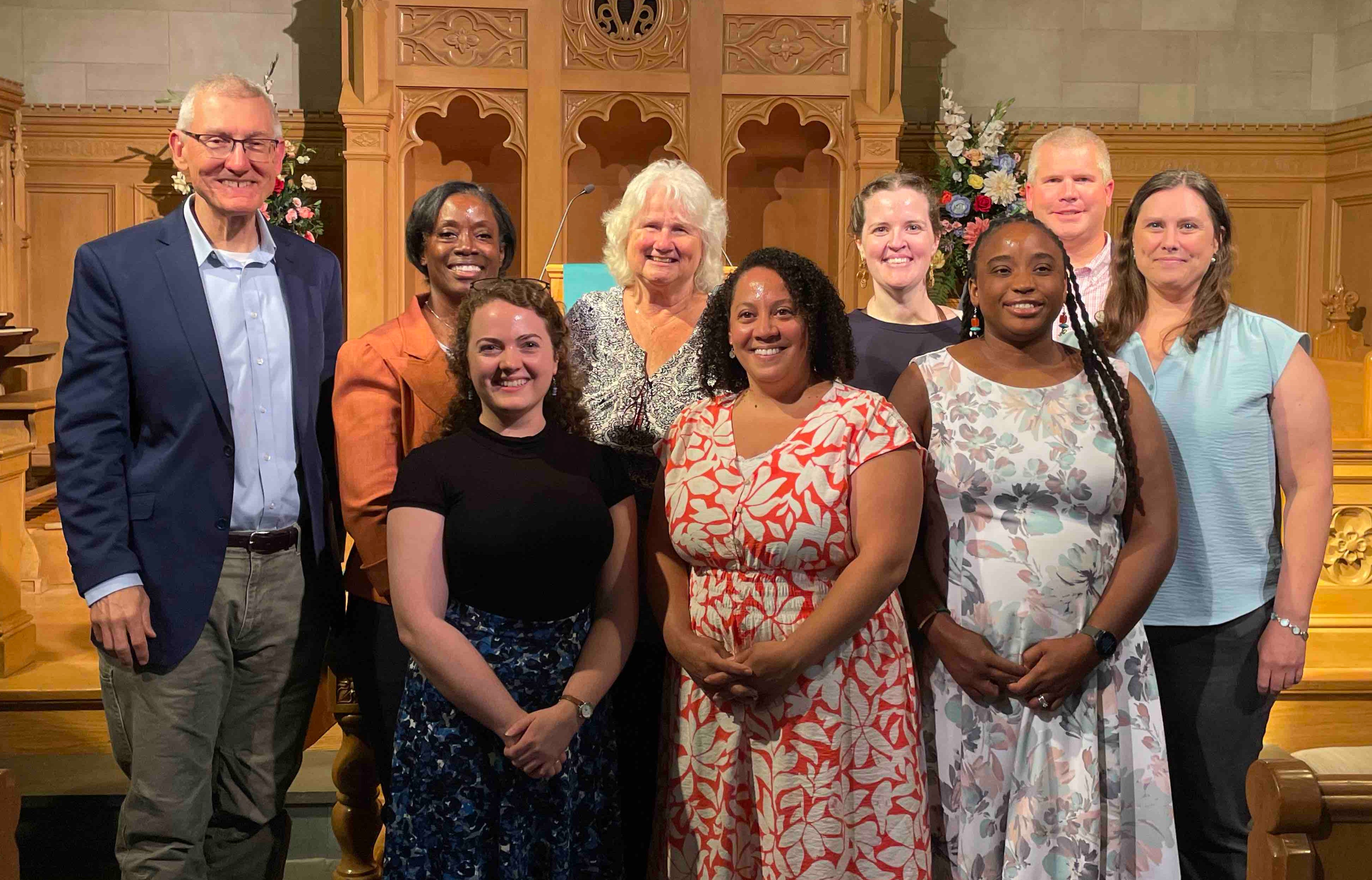
All smiles!
Martha and Mary - Form and Emptiness?
Well and truly said, Russell. Thank you and thank you for the generative work you’ve done through your work with CareNet.