
resurrection friday

Three of the four Gospels say that, between the hours of twelve and three on the day Jesus was crucified, the whole earth went dark, and at three, when Jesus died, the curtain in the Temple was torn in two, top to bottom. And one of those three, the Gospel of Matthew, says additionally that, when Jesus died, the earth shook, rocks split, tombs opened, and dead people were raised. A spiritual force was being unleashed, and it was powerful enough to darken the sky, shake the earth, and raise the dead.
I spent those hours today, twelve to three, sitting in the woods, listening to birds, meditating, and reading the Gospel accounts of Jesus’ arrest, trial, and execution. It’s hard to miss, in those stories, the jealousy and self-deceit of the accusers, the brutality of the soldiers, and the political spinelessness of Pilate, but what struck me most today were two things.
The first of these is the non-violence, non-aggressiveness, fearlessness, and plain-truth-speaking of Jesus. I wrote yesterday about Jesus in Gethsemane and the emptying of will that happened in him there, and every word he speaks after he leaves that garden, while empty of will, is full of clarity. While still in the garden, he tells one of his defenders to put away the sword, but the words he speaks through the night and the following morning cut through the pretense, dishonesty, and cowardice of everyone who engages him. He does not defend himself or plead for his life. He is often silent.
“Are you the King of the Jews?”
“You have said so.”
“If you are the Messiah, tell us.”
“If I tell you, you will not believe, and if I question you, you will not answer.”
“Is that how you answer the high priest?”
“If I have spoken wrongly, testify to the wrong. But if I have spoken rightly, why do you strike me?”
“Are you the King of the Jews? . . . Your own nation and the chief priests have handed you over to me. What have you done?”
“My kingdom is not from this world. If my kingdom were from this world, my followers would be fighting to keep me from being handed over. But my kingdom is not from here.”
Jesus is rooted in truth and love—he sees, he knows, he understands--and nothing that happens through the night can uproot him.
The second thing that struck me today was the detail I mentioned above: how, at Jesus’ death, resurrections began happening immediately. This piece of the story doesn’t get highlighted very often, perhaps to save the resurrection spotlight for Jesus on Sunday, but it is important and powerful. The death of this faithful one releases an energy that immediately alters the ordinary laws of Earth.
Before we get to this moment in the story, back when Jesus was an itinerant teacher and healer, he makes the statement that those who want to follow in his way will “take up” their own cross. We can’t know what this means by reading about it or thinking about it, but I believe that if we live with those words a while, if we make a little space for them—or even more, if we feel the vocal cord vibrations of the one who spoke them, if we even long to hear the vocal cord vibrations—those words will work on us and guide us into what they mean.
One of the senses I’ve come to have of what it means to take up a cross is: to receive in my body (and heart and mind) the toxic spewing, seeping, and scorching of others—or to use the theological word that some of you may have developed an allergy to, the sin of others—to receive without dissociating or otherwise numbing myself from what it feels like--and meet these toxins non-defensively and non-violently, with truth and love.
There’s a line in Paul’s letter to the Galatians, “Bear one another’s burdens, and thus fulfill the law of Christ.” It is a law of Christ, a spiritual law—a law not like a rule or a policy, do this and not that or else, but one like the law of gravity, this is the way it is—that we do bear the burdens, the wounds, the violence, the sin of others. They affect us, they hurt us, and we can’t live in this rough world without it happening. (The field of interpersonal neurobiology has borne this out, at least at the bio-psycho-social level: the nervous system is a social organ, and the energy emanating from one person’s nervous system is felt by the nervous systems of everyone else in their presence. Their stress becomes yours, in your body.)
What turns a burden into a cross is when we welcome it with truth and love. Truth as in: This is real and I feel it. Love as in: I will carry it with you.
I’ll add that it’s not a cross if we do this masochistically. Masochism is an expression of the ego (albeit a counterintuitive expression), and ego is a black hole that swallows energy into itself. A cross releases energy from itself. A true cross gives life to the dead and dying.
Like a lot of you, I imagine, I spend a fair bit of time wondering what I can offer the world right now. The money-driven corporate machine and its elected and unelected political facilitators are literally setting the world on fire and turning human intelligence and moral capacity to mush by means of a hand-held electronic device we carry willingly in our pockets (and pay the corporations money to do so). And what can I do about it? What can any of us do to disarm that death star?
Believe it or don’t, but the story says this: Put away the sword. Renounce all violence. Take up the cross. Bear one another’s burdens. Speak the truth. Trust in love.
Resurrection begins immediately.
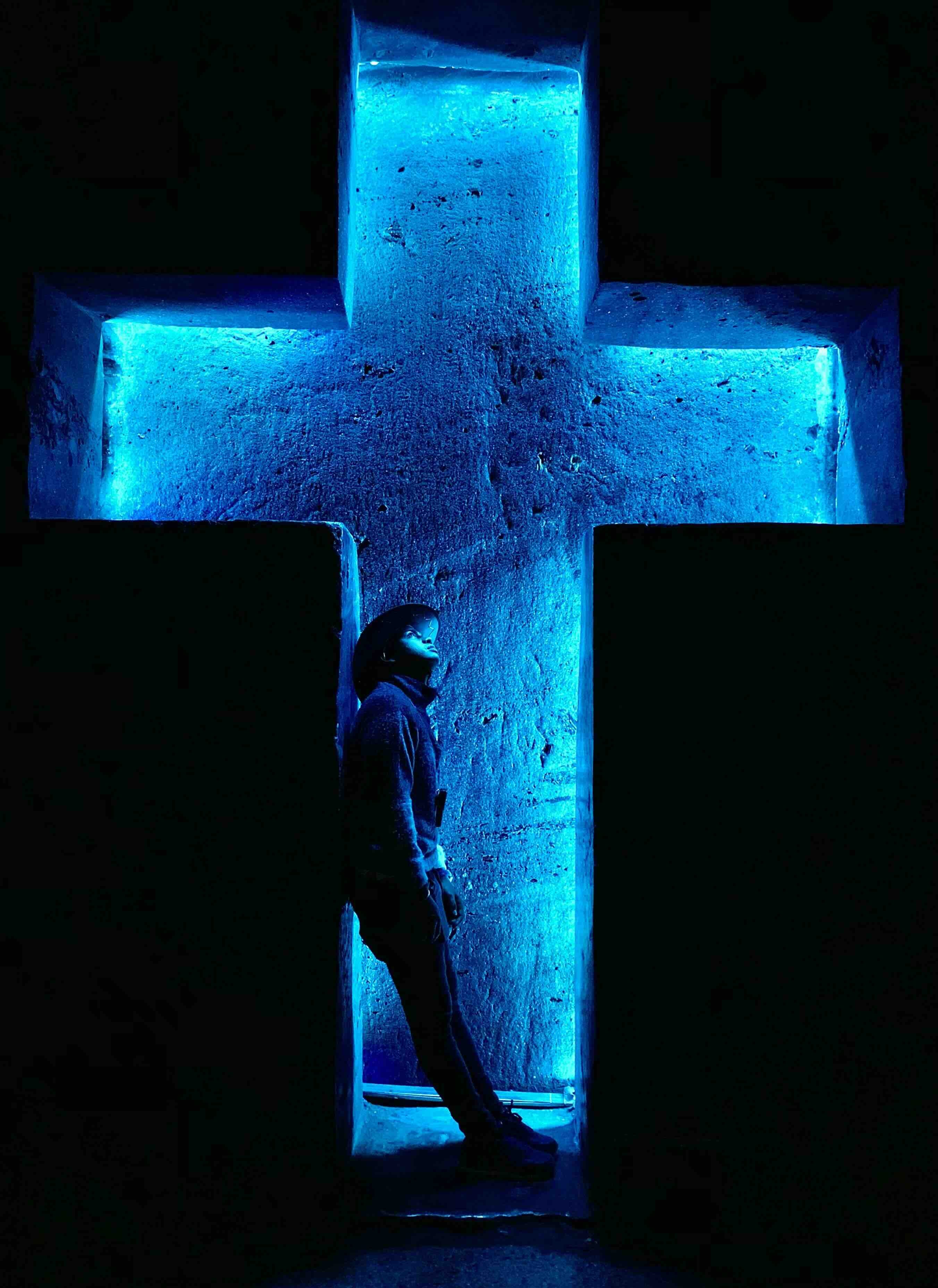
photo credit: Luis Mendez (Pexels)
Beautifully said 🙏🏽✨️